


South Carolina attorney proves to be the ‘natural’ his instructors envisioned
By Brian Cox
Geoff Kostrzebski started playing hockey when he was 8 years old. He had no idea at the time, of course, that much of what he learned about the sport he loved was also sound training for a career in law.
He learned the importance of preparation and teamwork, but he also learned how to deal with different styles of leadership and how to respond to tough coaching.
“I think I’m able to see through the delivery and get the message,” says the Collins & Lacy, P.C. associate, who joined the firm last November. “For most people, I think that getting involved with sports is the first time they’re exposed to the importance of determination, perseverance, and how to face adversity.”
For much of his childhood, however, Kostrzebski never imagined those lessons would carry him into a courtroom.
Growing up in Woodbridge, Va., just outside Washington, D.C., he thought he already knew exactly who he was.
“If you talked to me from 0 to 16 years old,” he says, “and asked, ‘Who are you, Geoff?’ I’d say, ‘I’m a hockey player.’”
The son of a Marine who later built a career in defense contracting, Kostrzebski grew up in a household where professionalism, discipline, and hard work were simply expected. His father attended every practice and every hockey game, expecting his son to always give his best effort. Hockey quickly became the center of Kostrzebski’s life, consuming weekends with long drives to tournaments throughout the Northeast and shaping his competitive mindset.

Like many young athletes, he envisioned playing at the next level. He hoped to earn a Division I scholarship and continue building a future around the game, but that plan didn’t work out.
Looking back, Kostrzebski says that disappointment became one of the first major turning points of his life. The dream he had carried for years suddenly disappeared, leaving him to answer a question he had never really considered before.

Geoff played in the club hockey league at the University of South Carolina. His parents, Ed and Laura Kostrzebski, were proud supporters.
“I'm not playing hockey anymore,” he recalls thinking. “There's no future there. And then I had to kind of look around and go, okay, who am I really?”
The search for that answer eventually brought him south.
During the winter of his senior year of high school, while considering colleges, he and his family traveled to Columbia, S.C. to watch the annual South Carolina-Clemson football game. After years of enduring cold winters while traveling for hockey, he found himself standing in 70-degree weather in late November.
“I was just like, ‘What am I doing? Why would I not just come here?’”
He enrolled at the University of South Carolina, initially majoring in insurance and risk management. The transition proved more difficult than he expected. Still processing the end of his hockey ambitions, his attention wandered in a dozen different directions.
He became fascinated by finance, spent countless hours reading about the stock market, tried launching a custom mug business, brainstormed coffee delivery services for college students, and chased entrepreneurial ideas that rarely lasted more than a few months.
“My brain was going in a million directions,” he says.
After a candid meeting with an academic advisor, Kostrzebski realized he simply wasn't invested in the business curriculum. Instead of forcing the issue, he switched to political science, a subject that had long interested him.
Political philosophy captivated him. He entertained the possibility of becoming a professor. Politics seemed equally appealing, particularly in the aftermath of the 2016 presidential election. Washington, D.C., beckoned, and he imagined himself working on Capitol Hill.
Even then, however, he wasn't entirely sure where his interests would ultimately lead.
Outside the classroom, hockey remained part of his life through the university's club team, providing both an athletic outlet and an instant community of friends. At the same time, another work experience would unexpectedly turn his attention to the legal profession.
To pay the bills, Kostrzebski worked as a bartender. He quickly learned that success behind the bar required more than mixing drinks. It demanded conversation, confidence, and the ability to connect with complete strangers of any age and from every imaginable background.
His manager continually pushed him outside his comfort zone, reminding him that greeting guests and making them feel welcome was part of the job. He became comfortable talking with people, reading personalities, and adapting to unpredictable situations – skills that would later prove invaluable both as a public defender and as a litigator.
“I learned how to talk to people,” he says. “That was a serious period of growth.”
Around the same time, another important relationship was taking shape.

Geoff and his wife, Ashton, met his senior year in college when he was bartending and she was waiting tables. The couple have three dogs: Scout, Link, and Nala.
He met his future wife, Ashton, who was working at a nearby restaurant while pursuing her own educational goals. As their relationship deepened, Kostrzebski found himself rethinking his plans to leave South Carolina after graduation. Rather than moving to Washington, he decided to stay in Columbia and explore law school.
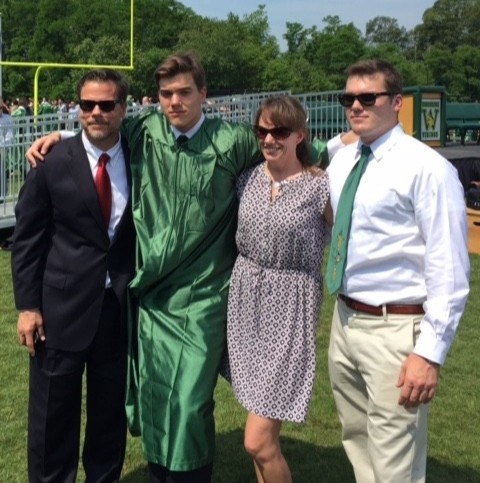
Geoff’s family, including his parents, Ed and Laura, and his brother, Brad, celebrate his graduation from high school in Woodbridge, Va.
Even then, becoming an attorney wasn't necessarily part of a lifelong plan.
His only real exposure to lawyers had come through an intense hockey coach who happened to practice law and, later, attorneys he met while bartending during happy hour. Watching one legal team celebrate a courtroom victory left an impression, but he still entered law school without a clear vision of where a legal career might take him.
He remembers being surprised to find law school more energetic, collaborative, and socially engaging than he imagined.
During his second year, he signed up for Trial Advocacy, a class that ultimately directed the course of his career.
The class was taught by practicing attorneys Clark Newton and Richard Willis, who recognized something in Kostrzebski that he hadn't yet fully recognized in himself. More than teaching courtroom technique, the professors gave him confidence.
“They told me, ‘You're a natural at this. You should look into litigation,’” recalls Kostrzebski. “They really reinforced the idea that, ‘Hey, you're good at this.’”
For a student wrestling with the same imposter syndrome common to many aspiring lawyers, their encouragement became the catalyst that finally brought his many interests into focus.
Rather than pursuing politics or academia, he decided to lean into litigation.
Following their advice, Kostrzebski sought courtroom experience as quickly as possible, accepting an internship – and later a full-time position – with the Richland County Public Defender's office.
It was exactly the challenge he wanted.
Within days, he found himself standing before judges, meeting clients in jail, responding to prosecutors' arguments, and learning to think on his feet.
“I got what I wanted,” he says. “It was very intense, and it was a big learning curve.”
It seemed that overnight, he inherited hundreds of cases and the enormous responsibility that came with them. The work was stressful and emotionally demanding.
But it also confirmed that he had found the right kind of work.
After a year as a public defender, Kostrzebski began looking for an opportunity to apply those courtroom skills in civil litigation. The timing proved perfect.
Last November, he joined Collins & Lacy, a firm known throughout South Carolina for its defense litigation practice. The transition felt natural. He already knew several attorneys at the firm, many of whom had backgrounds as prosecutors and public defenders themselves, and he appreciated both the firm's collaborative culture and its commitment to practical, efficient advocacy.
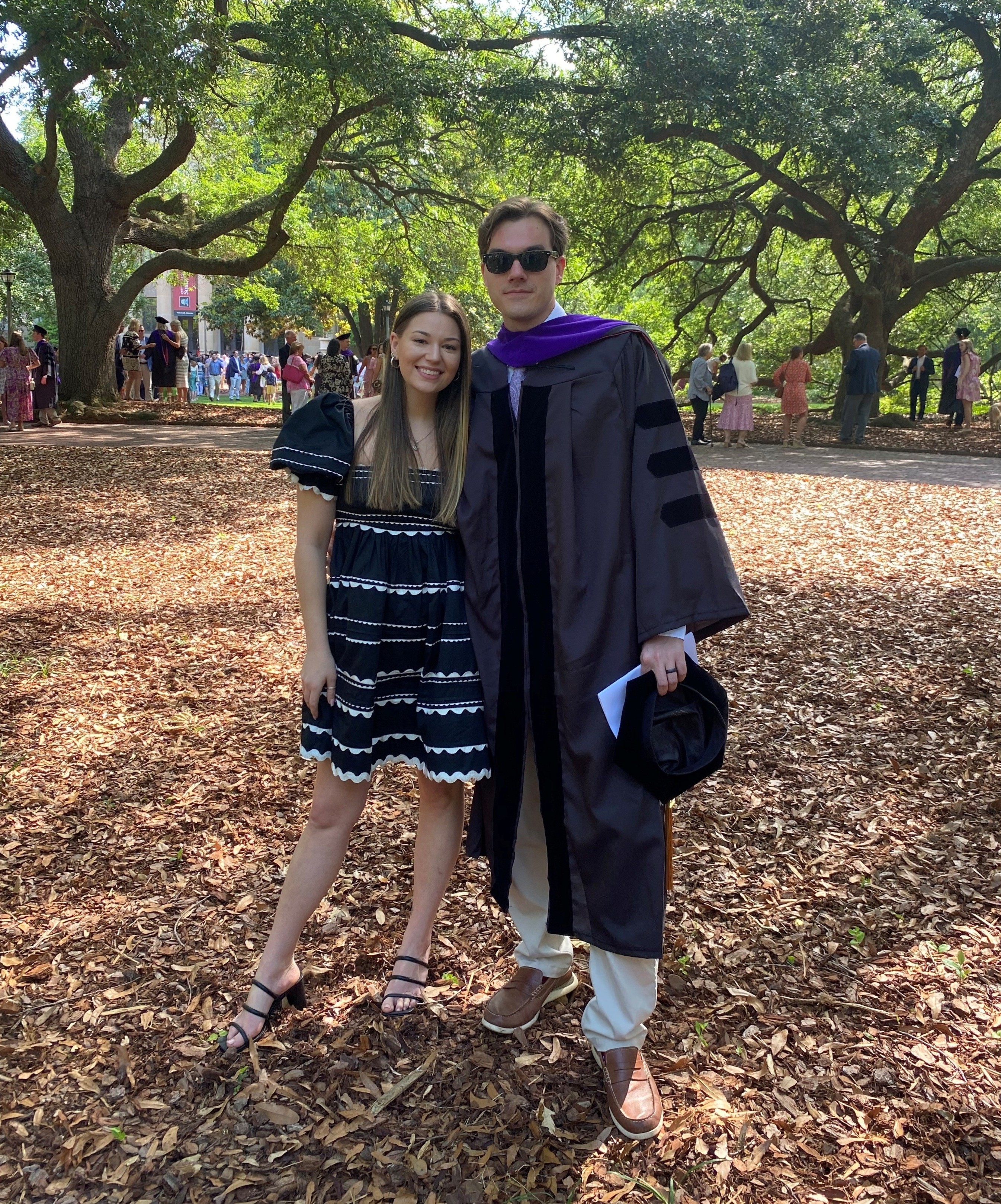
Geoff and Ashton on the day he graduated from University of South Carolina Joseph F. Rice School of Law.
Today, he works primarily on construction, premises liability, trucking, and insurance defense matters. The subject matter may differ from criminal defense, but the intellectual challenge remains much the same.
Every new assignment presents another opportunity to learn unfamiliar law while developing practical litigation strategies.

Geoff gained valuable insight into the legal profession from attorneys he met while tending bar during college.
Outside the office, Kostrzebski has embraced a quieter pace of life with Ashton and what he jokingly describes as their small zoo of pets: three dogs, two cats, a fish tank, and a backyard that has become a haven for birds. A devoted South Carolina athletics fan, he also follows his beloved Buffalo sports teams and remains an avid baseball enthusiast. To balance the demands of litigation, he has made yoga part of his regular routine, finding in it both exercise and a welcome release from the pressures of legal practice.
The search that began when hockey ended has, in many ways, come full circle.
The qualities that once made him a dependable teammate – resilience, coachability, adaptability, and composure under pressure – now define him as a young litigator. The path itself may have been winding, but every stop along the way, from bartending and political science to the public defender's office, prepared him for the work he does today.
“When I'm dealing with a new issue, a lot of times I'm having to learn,” he says. “That is exciting to me.”
As his law professors assured him: He’s a natural.