


Gerrymandering
Tilting the balance of power tests strength of democracy
By Tom Kirvan
In the 2024 presidential election, which was one of the most hotly-contested in recent history, just 65.3 percent of those eligible to vote cast ballots, according to figures released last year by the U.S. Census Bureau.
The nearly 157 million citizens who voted represented just 63 percent of the voting-eligible population in the U.S., raising important questions about the nature of “government by the people,” which is a cornerstone of representative democracy.
By most accounts, the supposed hero of the democratic system is the voter, commonly described as the ultimate source of all authority. The fact that tens of millions of Americans are so unresponsive to the system that they do not vote is the single most remarkable fact about it.
People apparently do not participate because they feel the system holds no benefits for them, or are generally apathetic about politics and political issues.
Some political observers and scholars believe that the legislative practice of “gerrymandering” has contributed to voter apathy, permitting redistricting that dilutes the voices and power of the people.
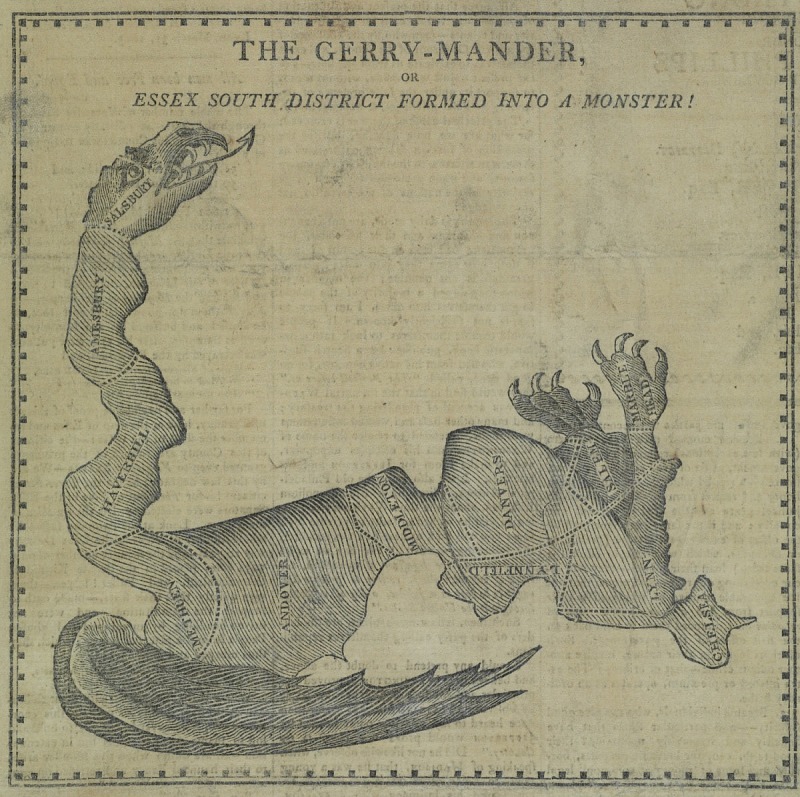
1 Cartoon, "The Gerry-Mander", 1813
The term was coined in March 1812, shortly after Massachusetts Governor Elbridge Gerry signed a controversial redistricting bill designed to keep his party in power. In response, The Boston Gazette published a political cartoon of one oddly-shaped, snaking district in Essex County. The newspaper’s cartoonist added a head, wings, and claws to the map, famously declaring it a “salamander,” which opponents of the governor quickly dubbed the “Gerry-mander.”
In the centuries since, gerrymandering has become a legislative artform for deliberately manipulating electoral district boundaries to secure an unfair political advantage for one party over another. The practice, which has been the subject of countless cases considered by the U.S. Supreme Court, is nearly as old as the United States itself, continuously evolving from early constitutional battles to modern algorithmic map-making.
In its most basic form, the practice hinges on two enduring strategies used by mapmakers: (1) Cracking – spreading opposition voters thinly across many districts to dilute their voting power; and (2) Packing – concentrating as many opposition voters as possible into a few specific districts so they easily win but yield fewer overall seats.
The political urge to redraw maps has gained steam in recent months after the Supreme Court in April weakened the landmark Voting Rights Act of 1965, raising the bar to bring a discrimination claim under the civil rights law. Section 2 of the Voting Rights Act was specifically meant to protect the ability of minority voters to get some political representation in legislatures and Congress by preventing maps that diminish their voting power.
Since the Supreme Court decision in Callais v. Louisiana, gerrymandering has ramped up in many regions, with both Republican- and Democratic-controlled states engaging in a series of unprecedented mid-decade map revisions to secure advantages in the 2026 midterms this November.
The Republican effort to redraw maps has been encouraged by President Donald Trump, who in May called on GOP states throughout the country to use the occasion to gerrymander their maps for political gain.
“The byproduct is that the Republicans will receive more than 20 House Seats in the upcoming Midterms,” Trump wrote in a post on Truth Social in May.
Shortly after the Supreme Court ruling, Louisiana Governor Jeff Landry, a Republican, declared an “emergency” in his state, ordering the delay of primary elections so that GOP lawmakers in the state legislature could redraw congressional boundaries. Several other states – including Alabama, Mississippi, South Carolina, Tennessee, and Texas – have taken similar action, a move that is “aimed at wiping out Black political power” in those states, according to an analysis from Democracy Docket.
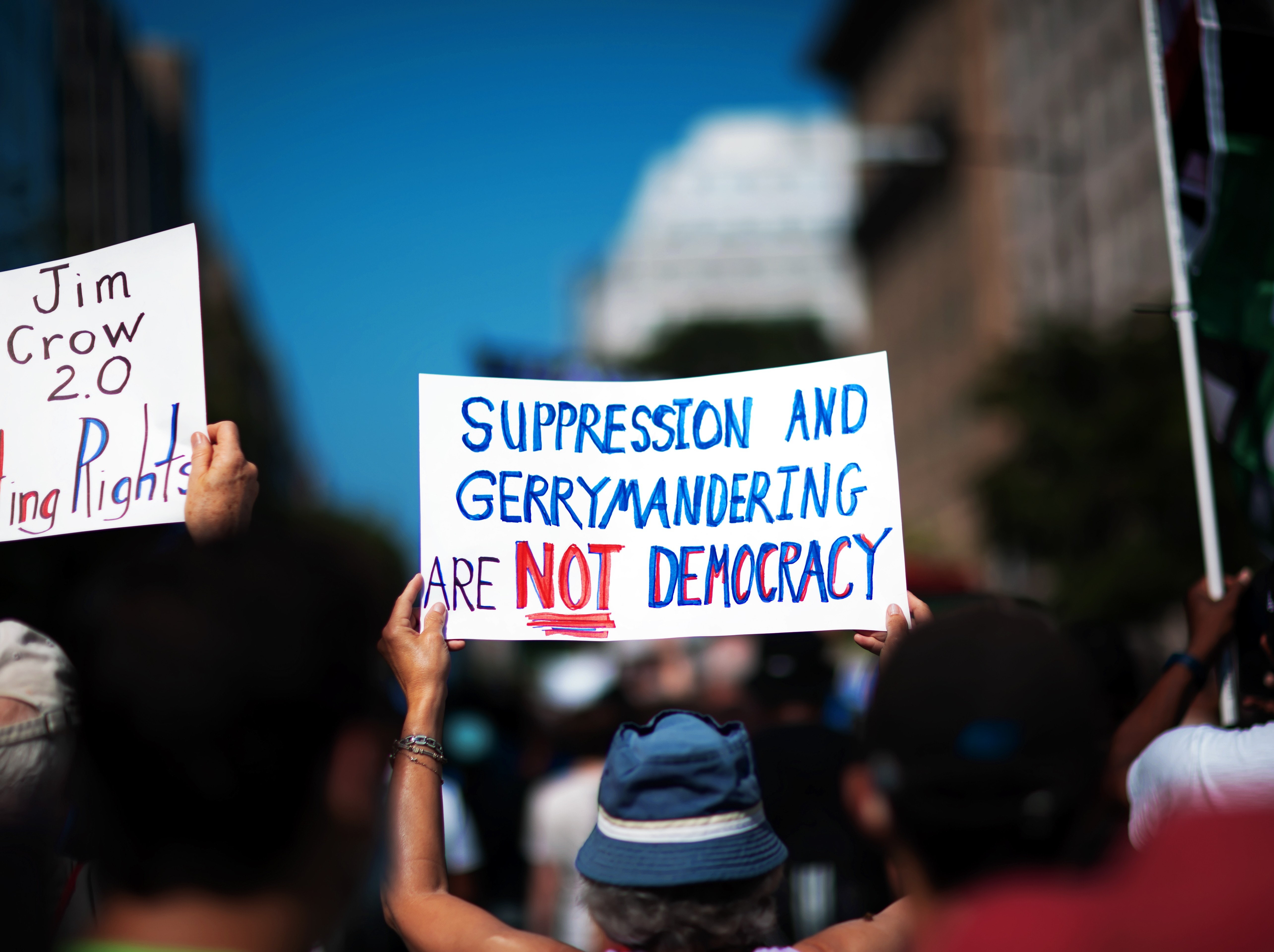
2 © Johnny Silvercloud / Shutterstock.com
U.S. Rep. Alexandria Ocasio-Cortez (D-New York) blasted the Republican moves, telling reporters that if the GOP continues trying to redistrict their states to gain a political edge in the 2026 midterms, then Democrats should respond in kind. A staunch proponent of redistricting reform to eliminate gerrymandering, Ocasio-Cortez said that if Republicans persist in efforts to redraw boundaries, Democrats shouldn’t take a passive approach.
“If Republicans are going to redraw North Carolina, if they’re going to redraw Texas, if they’re going to redraw and gerrymander every one of their states, then unfortunately, we have to provide balance to that until we get to the day when can all finally agree to put this behind us and pass nonpartisan gerrymandering federally,” Ocasio-Cortez declared.
Michael Li, of the Brennan Center for Justice, said that gerrymandering “used to be a once-a-decade thing” after each Census, but that is no longer the case.
“In the summer of 2025, Texas’s GOP-controlled legislature aggressively redrew its congressional map to target the political power of communities of color and try to create five more Republican seats in time for the 2026 midterms,” wrote Li. “The new map takes gerrymandering to a new extreme. Under the map that Texas originally adopted after the 2020 Census, around two-thirds of districts favored Republicans – an extraordinary skew in a state where Sen. Ted Cruz received only 53 percent of the statewide vote when running for reelection in 2024. However, the new Texas congressional map goes further, putting in place a map where Republicans could win 80 percent of seats in a favorable election cycle.
“Texas’s aggressive moves have set off a nationwide redistricting war that shows no signs of ending anytime soon,” Li said, pointing to Democratic gerrymandering efforts in California, Illinois, and Virginia.
The new era of redistricting is indicative of a seismic shift in how voting is measured in future elections, according to Benjamin Schneer, assistant professor of public policy at Harvard Kennedy School.
“These Supreme Court decisions along with abundant fine-grained data on voter registration and past votes allow for maps that are really fine-tuned to give a party a large advantage,” Schneer said.
“Until maybe 10 or 15 years ago, the courts thought that the idea of partisan gerrymandering was generally bad, even if they weren’t able to come to a decision about how to adjudicate it and to identify what is and what is not a partisan gerrymander. But now, we’ve shifted to a world where gerrymandering for partisan advantage – to advance the power of a particular party – is seen as a legitimate redistricting criterion, along with other traditional criteria like compactness and contiguity.”
In light of this ongoing battle, some states have adopted a common-sense approach, creating nonpartisan redistricting committees or commissions.
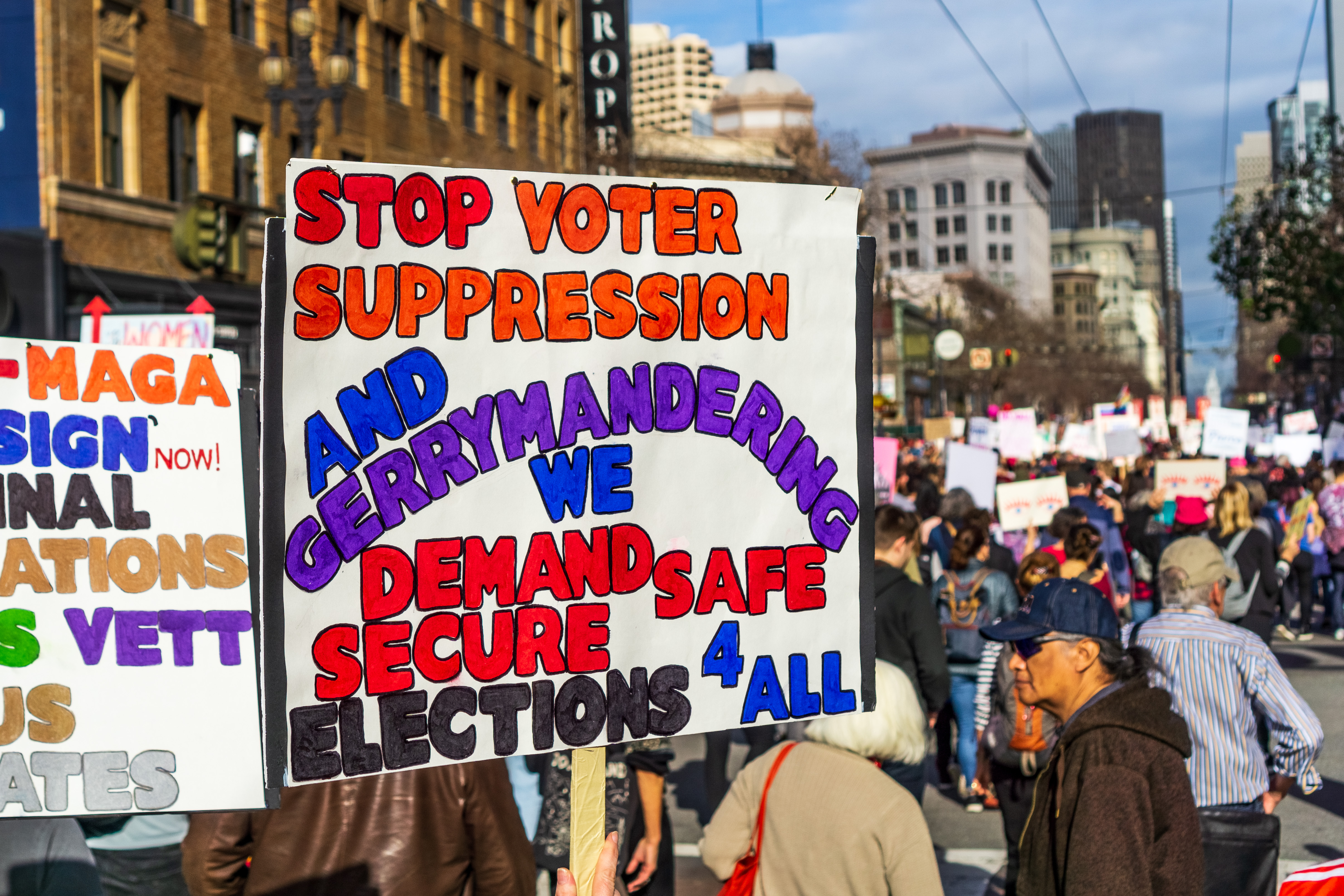
3 © Sundry Photography / Shutterstock.com
In Michigan, for instance, voters adopted a constitutional amendment establishing the Independent Citizens Redistricting Commission on November 6, 2018, overwhelmingly approving a ballot initiative. This amendment transferred the power to draw state legislative and U.S. Congressional districts from the state legislature to a 13-member citizen commission.
Other states that employ commissions include Arizona, California, Colorado, Idaho, Montana, and Washington, while hybrid models are utilized in Hawaii, New Jersey, New York, and Pennsylvania.
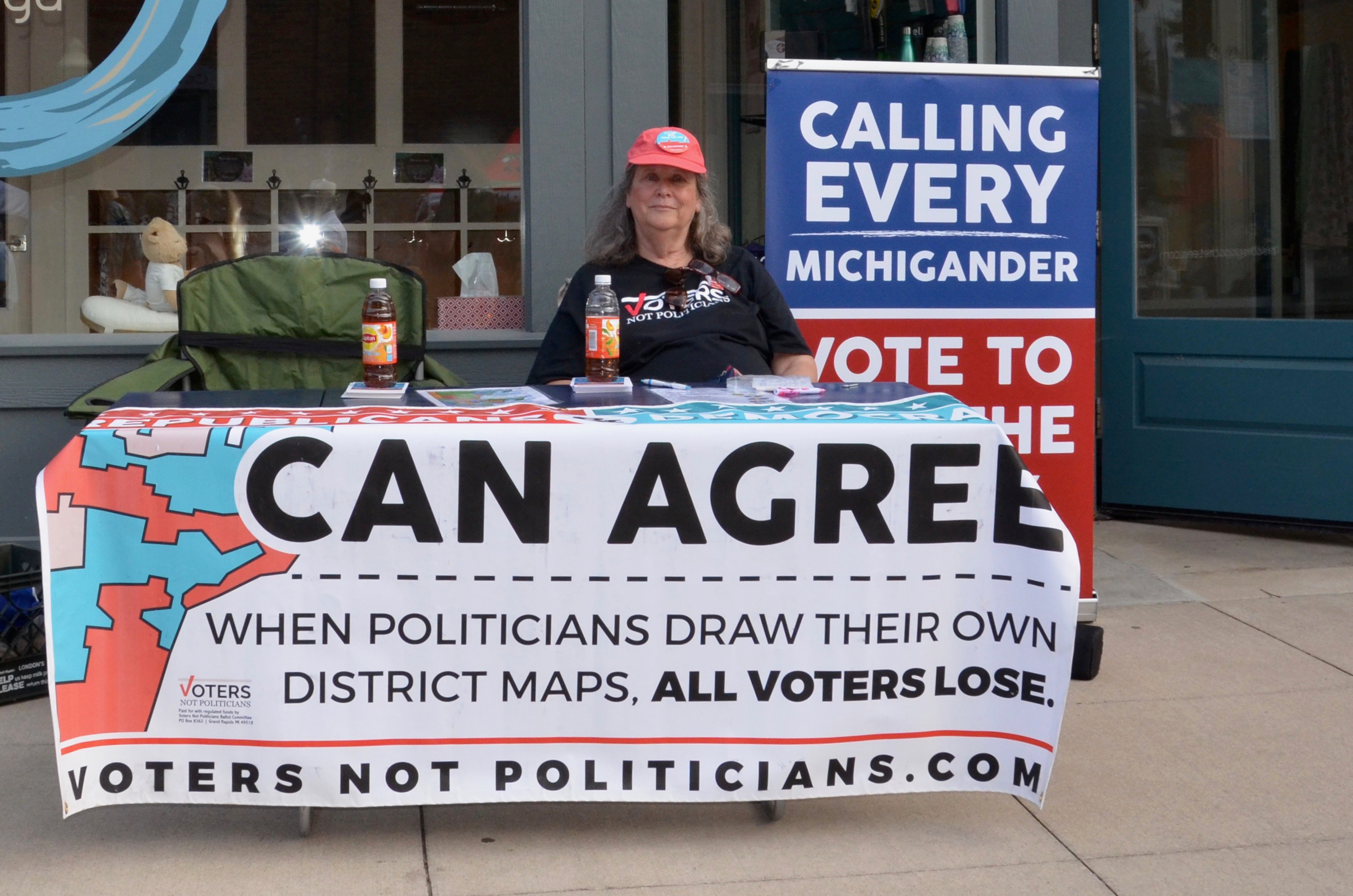
4 © Susan Montgomery / Shutterstock.com
While many public officials contend that any redistricting reform must be done on a national level, they also acknowledge that the commissions empower non-political actors to draw fair lines that represent the interests of the public rather than politicians.
“In general, when Democrats control state governments, they create independent redistricting commissions,” said David Tatsuo Imamura, an attorney and former chair of the New York State Reapportionment Commission. “When Republicans control state governments, they push through Republican gerrymanders. It cannot be that only blue states have independent redistricting processes while red states draw whatever lines they want. All states together must adopt uniform redistricting reforms.”
Image Credit:
Honorable Michael V. DiSalle in memory of Thomas H. Williams (1813). Cartoon, "The Gerry-Mander", 1813 [Newspaper Cartoon]. Smithsonian. Retrieved June 29, 2026 from https://www.si.edu/object/cartoon-gerry-mander-1813%3Anmah_509530
Johnny Silvercloud (2021 August 28). March On for Voting Rights in Washington, D.C. "Suppression and Gerrymandering are Not Democracy" [Photograph]. Shutterstock. Retrieved June 29, 2026 from Shutterstock
Sundry Photography (2019 January 19). San Francisco, Cali., U.S. – Participant to the Women's March event holds sign referencing voting suppression, gerrymandering while marching on Market street in downtown San Francisco [Photograph]. Shutterstock. Retrieved June 29, 2026 from Shutterstock
Susan Montgomery (2018 July 12). In Michigan, a woman staffs a booth supporting the group Voters not Politicians at the Chelsea Sounds and Sights on Thursday Nights festival [Photograph]. Shutterstock. Retrieved June 29, 2026 from Shutterstock