A knack for overcoming challenges is a trademark for California attorney
Articles
Spotlight
View more from News & Articles or Primerus Weekly

By Brian Cox
There have been several occasions over the course of David Weiland’s life when people have told him he could not do something – whether it was an engineering project, a career shift, or a legal challenge.
His response was: “Just watch me.”
“I’ve always sort of had this attitude that I could do whatever it took to get something done,” he says. “I’m not afraid to get my hands dirty and get something done.”
Weiland, an equity partner at Coleman & Horowitt, LLP in Fresno, Calif., and chairman of its litigation department, traces the seeds of that mindset to his early days working with land surveyors in California’s Central Valley. As a teenager, Weiland worked on survey crews cutting through thick mesquite, climbing hillsides, and enduring long days under an unforgiving sun. It was exhausting, dirty work, but it taught him the value of effort and persistence.
“I learned the value of hard work,” he says.
He also learned that he didn’t want to do that hard work outdoors.
Weiland grew up in Hanford, a small city near Fresno that then had a population of roughly 17,000 people. He attended grammar school and high school there, graduating in 1967. He played baseball and basketball, lettering in both sports, and by his own account enjoyed a typical small-town upbringing. His wife lovingly refers to it as “Mayberry.”
His father’s career offered an early example of reinvention that Weiland himself would later echo. Initially a butcher shop owner, his father sold the business and became an insurance broker with Farmers Insurance, and later, a bail bondsman. The lesson was not lost on his son: careers could evolve, and effort could outlast limitation.
After high school, Weiland attended the College of the Sequoias in Visalia before transferring to Fresno State, a move that would permanently anchor him in the region.
“I got to Fresno and I liked it,” he recalls. “It was a good fit for me.”
Academically, Weiland gravitated toward math and science. Numbers came easily, and problem-solving felt natural. His next-door neighbor in Hanford was a licensed civil engineer, and through that connection – along with those early summers spent on survey crews – Weiland saw a profession take shape. He understood the trigonometry, the purpose behind the measurements, and the practical application of it all. Civil engineering made sense, and when the time came to choose a major, he went with what felt right.
He earned a degree in civil engineering, passed the licensing exam on his first attempt, and entered the profession at a time when job prospects were limited. Of two offers, he accepted one from Kings County, where he worked on road construction, maintenance, and development review. He eventually became deputy county surveyor and took on greater responsibility.
One project in particular helped define his early career. Tasked with converting open-burning garbage dumps into sanitary landfills, Weiland coordinated complex engineering efforts and regulatory approvals. He co-authored a national publication on the work, and at just 25 or 26, he flew to Miami – his first time on a plane – to accept a National Achievement Award on behalf of the county.
Yet despite the recognition, he sensed that public-sector work would not fulfill him long-term. He moved on to a Fresno-based consulting firm and began working with small cities across California. Airport runway reconstruction became a specialty of the firm, and with it came the opportunity to earn a pilot’s license. For a time, he flew himself to meetings at rural airports.
“It was a hoot,” Weiland recalls with a smile.
In the early 1980s, he joined two partners in the real estate development business, rehabilitating foreclosed properties for savings and loan institutions. Rather than seeing the shift as a departure from engineering, Weiland viewed it as another problem to solve – one that required the same discipline, precision, and tolerance for risk. It was profitable – until it wasn’t. Federal tax reforms in 1986 changed the financial landscape overnight. The business model collapsed.
When that happened, reinvention was not a retreat but a recalibration – an opportunity to apply hard-earned experience in a more controlled, purposeful way. Weiland launched his own engineering practice, taking on municipal and private clients. As a contract city engineer, he guided projects from entitlement through final inspection. But within a few years, he sensed that the work no longer challenged him.
That was when an offhand comment from a former public works director resurfaced: “You should go to law school.” It was something Weiland had never quite dismissed. He had once been accepted to San Joaquin College of Law, but circumstances had led him to delay. By 1988, the timing felt right. Once again, reinvention was not a step backward, but a deliberate move toward work that demanded deeper analysis, judgment, and accountability.
He applied, did well on the LSAT, and enrolled at San Joaquin at age 39. Law school was demanding but invigorating. Most of his classmates were also second-career professionals. Weiland worked full-time during the day and attended classes at night. After being named managing editor of the school’s new agricultural law journal, he sold his engineering practice and lived off the proceeds to finish strong.
He graduated in May 1992, passed the bar and was sworn in that December. Though a promising interview process with a respected Fresno law firm initially seemed like his entry point into practice, it ended in rejection – a setback, that forced him to rely on what he calls his “Plan B” instinct. With modest savings remaining, he rented shared office space and opened a solo practice with no clients and no guarantees.
Soon after, a professional negligence claim crossed his desk. An engineer had been accused of malpractice, but the potential client’s insurance company was hesitant to hire someone so new to the legal field. Weiland leaned on the credibility he had earned in his first profession.
“I told the claims representative, I’m a brand-new attorney – I’ve only been doing this for a month,” he recalls. “But I’m a licensed civil engineer. I know everything that needs to be done with a claim like this. If you give me a chance, I guarantee I’ll do a good job for you.”
She gave him the file, and he obtained a dismissal of the case within six months.
That single opportunity opened the door to more. That case became the first of many referrals, and over time, he built a steady insurance defense practice before broadening into representing business clients as well. The claims representative from that first case and her husband would go on to become family friends.
After six years as a solo practitioner, Weiland recognized that the demands of litigation and client service were becoming difficult to manage alone. He was invited to join Dowling, Aaron & Keeler. Two days before his professional move, he suffered a heart attack. He was 49.
“It was shocking,” he says. “As a solo practitioner, you tend to work more hours than you should.”
Six months after the heart attack and two months after joining Dowling, Aaron & Keeler, he underwent quintuple bypass surgery. His recovery coincided with the birth of his daughter, Julia. During that period, his new partners stepped in, absorbing his caseload without hesitation. They ensured that clients were cared for, deadlines were met, and Weiland was free to focus on recovery – support that went beyond professional obligation and reflected a level of personal loyalty he had not expected but never forgot.
Even in the face of personal health challenges, Weiland’s instinct was not to pause indefinitely, but to recover, recalibrate, and return with greater clarity about both his work and his life.
“It was an interesting year,” he says of 1999. “I remember it like yesterday. I returned to work part time in September. And by late October, I was going full steam again. I’ve been fine ever since.”
His return came with a renewed perspective. As his daughter grew and took an interest in swimming, he was determined to attend every one of her swim meets and water polo matches. He prioritized his daughter’s events, entering them into his calendar the same way he would a deposition or client meeting.
“I made it a point to attend all of those events,” he says. “I think it really gave me a better appreciation of what’s important in life.”
Weiland eventually became president of the firm and oversaw a period of significant growth, steering Dowling, Aaron & Keeler through the 2008 recession. In 2014, however, he made another difficult – and personally painful – decision to leave the firm. He had built a career there, occupied a beautiful office, and earned the trust of clients and colleagues alike. Still, something about Coleman & Horowitt, LLP felt right – not as a rejection of the past, but as a better fit for the future.
“The culture here is a great fit for me,” he says. “I have a top-notch assistant, access to multiple paralegals and associates, and partners I can bounce ideas off of.”
At Coleman & Horowitt, he transitioned into complex business litigation, construction, real estate, and transactional matters. He also remains a trusted resource to the many clients for whom he defended professional liability claims.
Service beyond his practice has long defined Weiland’s professional identity. He spent hours volunteering at his daughter’s school events – and there were many. He served as president of the Bulldog Foundation at Fresno State, where he remains a devoted supporter. He also serves on the board of trustees at San Joaquin College of Law, the very institution that launched his legal career. He even taught legal writing in the 1990s.
“Going back to law school made a big difference in my life,” he says. “I can say without any question that those four years were probably one of the most enjoyable periods of my life.” At the time, he could not have known that his future wife and a family who would later reshape his priorities were just ahead – but in hindsight, the decision opened the door not only to a second career, but to a fuller life than he could have imagined.
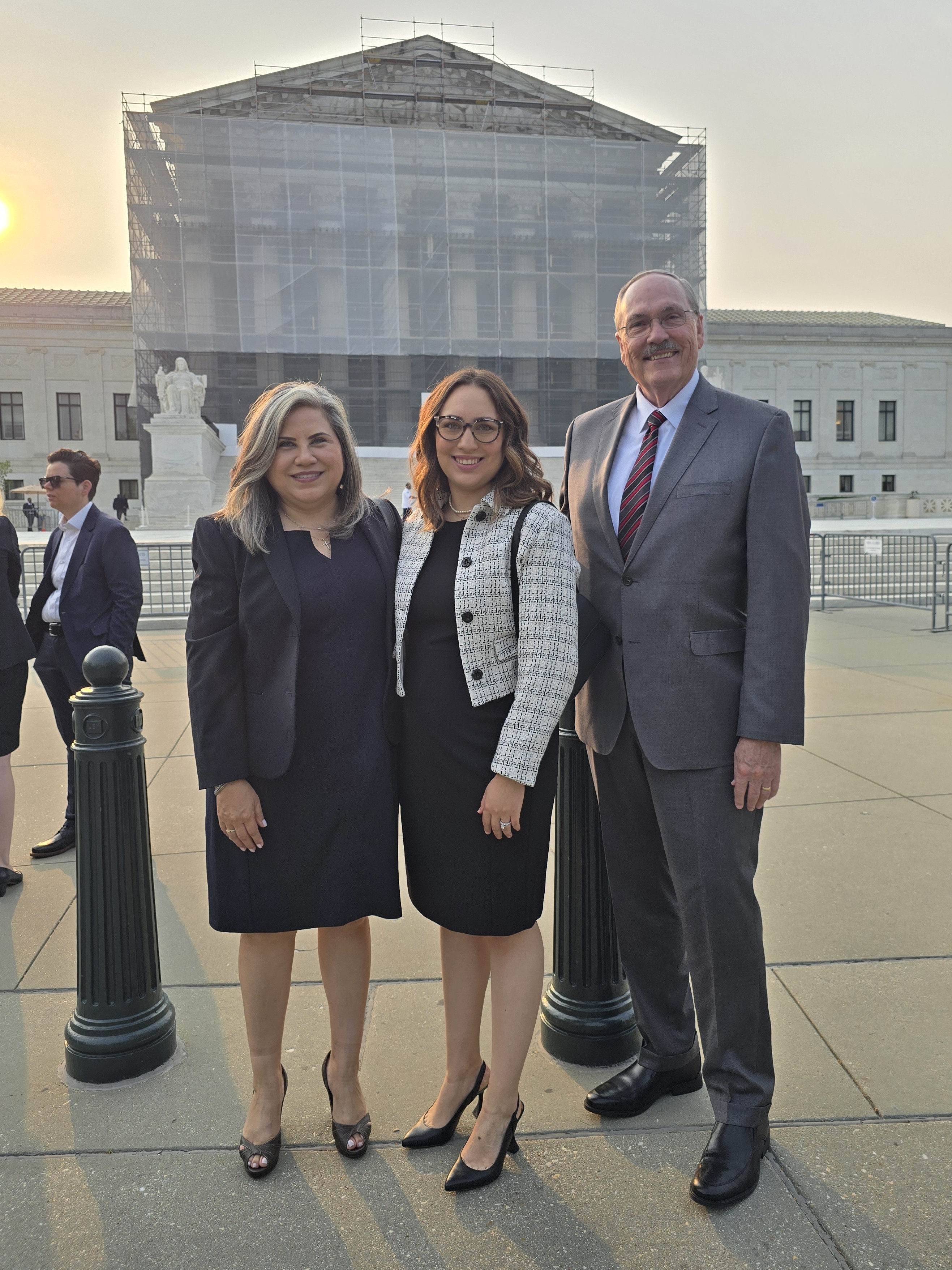
Among the milestones that have marked his journey, Weiland’s admissions to the San Joaquin College of Law Hall of Fame and to the Bar of the United States Supreme Court in Washington, D.C. stand out. In June 2025, he stood before the Court and took the oath alongside a select group of attorneys. After decades of practice, the moment symbolized not just achievement, but endurance.
Weiland has now been a lawyer longer than he was a practicing civil engineer. Still, he remains licensed as an engineer, and earlier this year, the California Board of Registration for Professional Engineers recognized his 50th year as a licensed civil engineer.
“My civil engineering colleagues still bug me about betraying them,” he says with a wry smile. “But I’ve been able to help a number of them with legal issues, so that tends to smooth things over.”
Weiland and his wife, Lillian, who also holds a law degree, have been married for nearly 30 years. Their professional paths first crossed when she interviewed for a position at his office. Though the job was not a fit, their connection was magic.
His daughter, Julia, now works at UC Davis Medical Center alongside her husband, a medical resident. His son, David, teaches history at the college level in Texas. His stepdaughter, Alice, is a schoolteacher and lives nearby with her family. Weiland loves to get updates about his five grandchildren and three great-grandchildren.
Weiland’s story is not about titles or achievements, though there are many. It is about how character endures when plans collapse, when health falters, and when success requires the willingness to begin again. Throughout each chapter – engineer, developer, lawyer, father, husband – Weiland has relied on the same foundation: adaptability, persistence, and the quiet confidence that if he stayed focused, he could figure it out. His path, forged through change and steady resolve, is a testament to what becomes possible when a person chooses not to give up, but instead, to move forward deliberately and purposefully. Reinvention, for him, was never retreat. It was simply the next challenge to solve.