


Bankruptcy attorney helps clients take full advantage of opportunity for a restart
By Brian Cox
Bankruptcy, according to California attorney Uzzi Raanan, is far more than simply a fresh start for a business or individual drowning in debt. The legal mechanism helps undergird the American economy.
After more than three decades of advising clients in bankruptcy and business reorganization matters, Raanan equates bankruptcy to a pressure valve that can release steam from a lagging or overheated economy. Jobs can be saved, entrepreneurship encouraged, and the economy preserved.
Bankruptcy law in the U.S. acts to stabilize the broader economic and political systems.
“If you look at other countries, many of them have emulated the United States’ bankruptcy system, recognizing that sometimes you’ve got to move on,” explains Raanan, a partner at Greenberg Glusker in Los Angeles. “Debts can be forgiven or restructured. There are ways of handling distressed entities and individuals without destroying them, and I think that’s where bankruptcy can be such a powerful force for good in our society.”

Raanan’s global lens on bankruptcy has been shaped by both professional experience and personal history. He describes bankruptcy as a kind of melting pot, a convergence point, where nearly every facet of a company’s existence comes into play. A business enters bankruptcy because of financial distress, but once there, employment matters, real estate holdings, pension obligations, contracts, and often cross-border assets, among others, must all be considered and resolved.
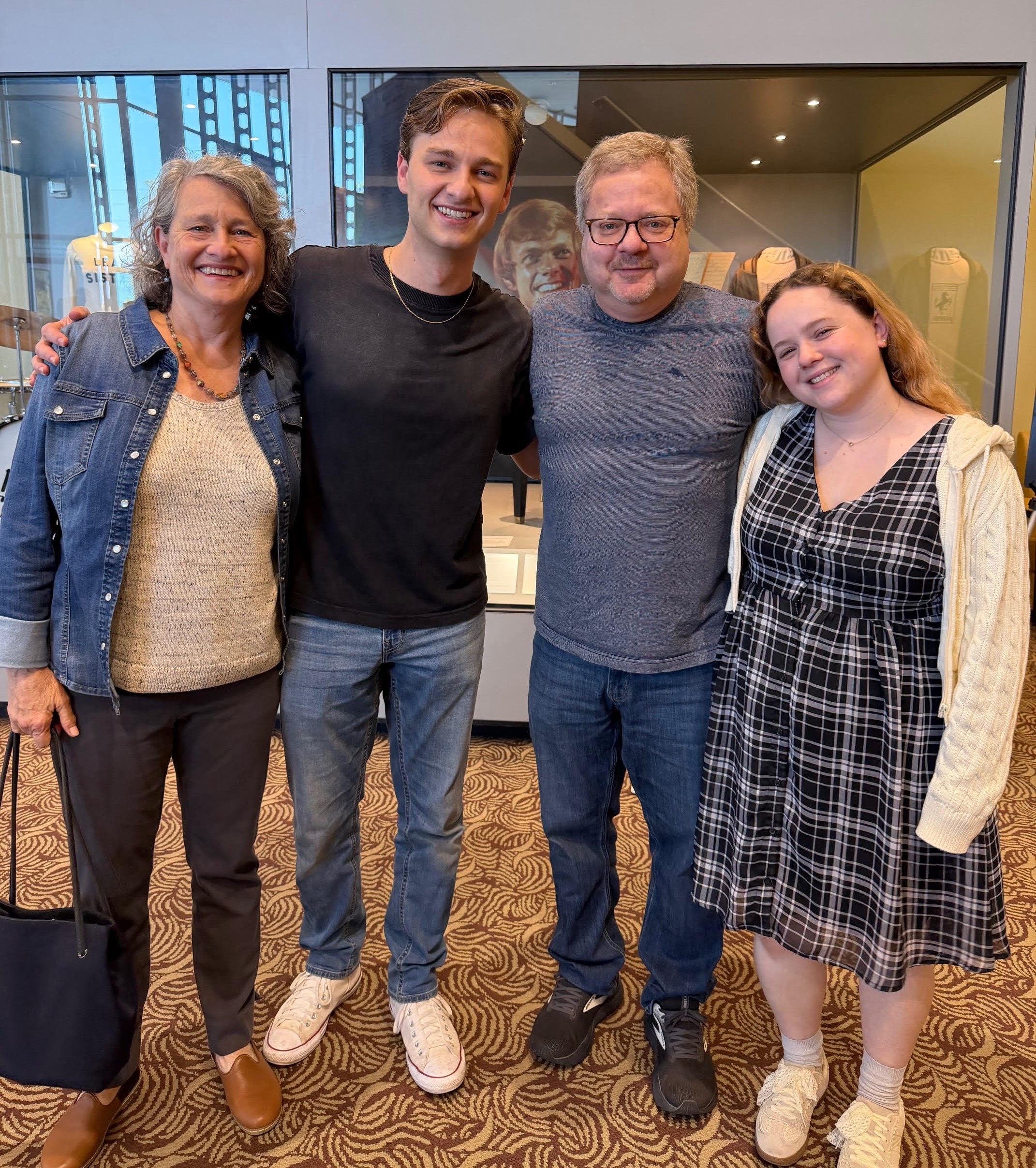
Uzzi Raanan with his wife, Beth, and their two children, Ben and Emma.
“Bankruptcy gave me the opportunity to work on a variety of interesting legal and social issues,” says Raanan.
The complexity of bankruptcy and the necessity of reconciling competing interests while dealing with limited resources continues to fascinate and engage him.
“The overarching goal in a bankruptcy case is to legally and equitably distribute the limited assets of debtors who owe much more than they can pay. How to do so in a complex financial system is the challenge that makes the practice of bankruptcy so rewarding.”
His practice has at times taken on an international dimension. Over the years, Raanan has handled matters involving assets located outside the United States, including cases with connections to Israel, that required coordination with courts abroad. The experience reinforced his interest in how different legal systems interact – an interest rooted in his upbringing.
Raanan was born in the U.S. but spent his early childhood in Israel. At the age of 13, he moved to California to live with relatives. The transition was jarring. He was introduced to a new country, a new language, and a new family structure at an age when most children are deeply rooted in familiar surroundings. He had grown up knowing friends from before kindergarten; suddenly, he knew no one.
“I’m sure that had a lot to do with who I became as a person,” Raanan reflects. “I think it was formative in how I approach the world today.”
That experience fostered a sensitivity to other people navigating uncomfortable or unfamiliar situations.
“I tend to sympathize with people who are in difficult situations because I have been there too,” he says.
Living abroad also shaped how he views the world and the United States’ role within it. He notes that growing up in a smaller country provided him with a perspective that differs somewhat from that formed by people raised in a global superpower.
“I think I see the world and other cultures differently,” he says. “That’s because I know that they are often affected greatly by what happens in the U.S. and in other powerful countries and they’re often powerless to shape their own destinies.”
After high school, Raanan attended San Diego State University, where he double majored in history and political science. His interest in politics and international affairs ran deep. For a time, he seriously considered a career in diplomacy but ultimately decided to pursue a legal career.

Uzzi and Beth at Iguazu Falls in Brazil.
Law school followed at University of the Pacific McGeorge School of Law, in Sacramento, Calif., where his academic focus initially leaned toward international law. He wrote for the Transnational Lawyer, where he authored an article examining the relevance of the Coordinating Committee for Multilateral Export Controls in a post-Cold War era. Conversations with professors and practitioners eventually persuaded him that the international law practice often centered on treaties and contract work, rather than the broader geopolitical engagement he envisioned.

Among his wide travels, Uzzi and his wife have visited Machu Picchu in Peru.
Raanan’s professional path took a decisive turn during law school when he was offered a summer job with the Office of the California Attorney General. That opportunity led to four years with the Attorney General’s Office, from 1992 to 1996, where Raanan worked primarily on writs and appeals within the criminal law division.
The experience honed his writing skills,
“I learned to approach my briefs from the perspective of the courts. This is because as a government lawyer you’re supposed to be somewhat objective,” he explains. “If you see a wrong, your job is not to win because the client is paying you. You’re there to affect justice. To seek the truth.”
Through appellate work, Raanan learned to write by imagining the audience that mattered most – the judges.
“When I draft a legal brief, I try to imagine what and how the judge would write their opinion,” he says, explaining that the goal is to convince “a person who’s spending a few minutes reading your brief that you have the better facts and legal arguments.”
“There’s a way of drafting an argument so a judge would adopt it as though he or she had written it. It is extremely satisfying when the court adopts an attorneys’ arguments as its own,” notes Raanan.
His approach of being persuasive without coming across as offensive became foundational to his work.
“You want to be persuasive without ignoring the contrary arguments and without coming across as offensive,” Raanan says. “Courts prefer vigorous but civil arguments. I think it’s an art to how you balance these competing interests.”
After four years in government service, Raanan transitioned to private practice, joining Manning & Marder, Kass, Ellrod, Ramirez, LLP when an opportunity arose to work on a high-profile appeal involving what was then the largest judgment against a law enforcement agency in the country.
While at that firm, Raanan also represented insurance companies in large qui tam private attorney general lawsuits targeting fraud rings that staged automobile accidents and fabricated injuries. When some defendants sought refuge in bankruptcy court, Raanan was tasked with pursuing them in that venue.
Raanan discovered quickly that he enjoyed the bankruptcy practice. In 2001, he joined Danning, Gill, Diamond & Kollitz, LLP, a prominent Los Angeles bankruptcy boutique firm, where he practiced for over 23 years.
When Danning Gill closed in January 2025, after over 70 years, Raanan had the opportunity to join Greenberg Glusker, transitioning from a specialized insolvency boutique to a firm with more than 100 attorneys across diverse practice areas.
“I’m a very curious person,” he says, noting that the move has allowed him to expand his practice beyond bankruptcy courts, while allowing him to offer his insolvency expertise to a broader platform. “I was very lucky to have the opportunity to join Greenberg Glusker, which is highly respected in the legal community,” he says.
Raanan is deeply involved in the legal profession. He has served as co-chair of the Insolvency Law Committee and chaired the Business Law Section of the State Bar of California. He also spent four years on the Board of Representatives of the California Lawyers Association. Writing remains a constant as well; he contributes to Westlaw’s Commercial Finance Newsletter and is known for critically analyzing appellate and Supreme Court decisions.
Outside the office, Raanan’s life is equally rich with stories. He married his wife Beth, in 1997, after meeting through a Los Angeles Jewish Federation leadership group, an experience that led to a Los Angeles Times feature about the benefits of volunteering and, unexpectedly, a cameo in a segment on “The Oprah Winfrey Show”. The couple honeymooned in Rome.

Uzzi and Beth on a trip to Alaska.
They have two children – Benjamin, an actor and NYU graduate, and Emma, a Chapman University graduate who works in education. Raanan enjoys travel, theater, politics, and researching family history, which spans continents, wars, and unexpected turns.
On his father’s side, his roots trace back to Germany, with records reaching into the 16th century. His great-grandfather served in the Bavarian Army during World War I; by World War II, that same ancestor would be imprisoned in a concentration camp. Another branch of the family helped shape the early fabric of Israel – his great-aunt was a co-founder of Bat Yam, a city just south of Tel Aviv.

Los Angeles bankruptcy attorney Uzzi Raanan is a Dodgers fan.
A great-uncle took a different path entirely, emigrating to the United States and opening a used furniture store before a trip to Mexico City changed the course of his life. There, he met the grandson of Diego Rivera, began acquiring Mexican artwork, and ultimately became arguably the largest private collector of Rufino Tamayo’s art. He ultimately donated a substantial portion of his collection to the Los Angeles County Museum of Art.
For Raanan, those stories – of survival, reinvention, and cultural exchange – are more than family lore; they are reminders of how individuals navigate upheaval and build something lasting in its aftermath.
“I love hearing people’s stories,” he says. “I think every family has interesting stories to tell.”
After decades of practice, what continues to engage Raanan is not just the outcome of a case, but the reasoning behind it – how judges balance competing interests, limited resources, and the rule of law to reach results that allow the system itself to keep functioning.