Bits of fatherly advice helped California attorney discover a fulfilling career pathway
By Brian Cox
The course of Travis Neal’s decades-long legal career has been significantly influenced by two key junctures at meals with his father.
The first took place in a British-style pub that served bangers and mash in Redwood City, Calif. Neal had recently finished his junior year at Stanford University where he was studying art history. He was considering dropping out. He’d spent the summer working at a tech startup, and the CEO – who himself was a proud college dropout – had offered Neal a significant salary and benefits package to join the company full time. It was at the height of the tech boom near the turn of the century, and entrepreneurial spirits were sky high.
“I was deeply conflicted,” recalls Neal, now a trust and estates planning attorney with Brothers Smith LLP in Walnut Creek, Calif. “Even if it didn’t end up working out, it was pretty good money and there was the potential for stock options.”
Over sausages and a pint, he nervously laid out for his father all the pros and cons of the decision he faced.
“I don’t really know what I’m going to do,” he confessed.
His father, who was an attorney, remained calm and relaxed. Rather than insisting Neal continue his education or encouraging him to seize the job opportunity, he outlined all the things he’d loved about his senior year of college and how much it meant to graduate with the people he’d gone to school with for the previous three years.
“I think you should at least think about those things, too,” he told his son.
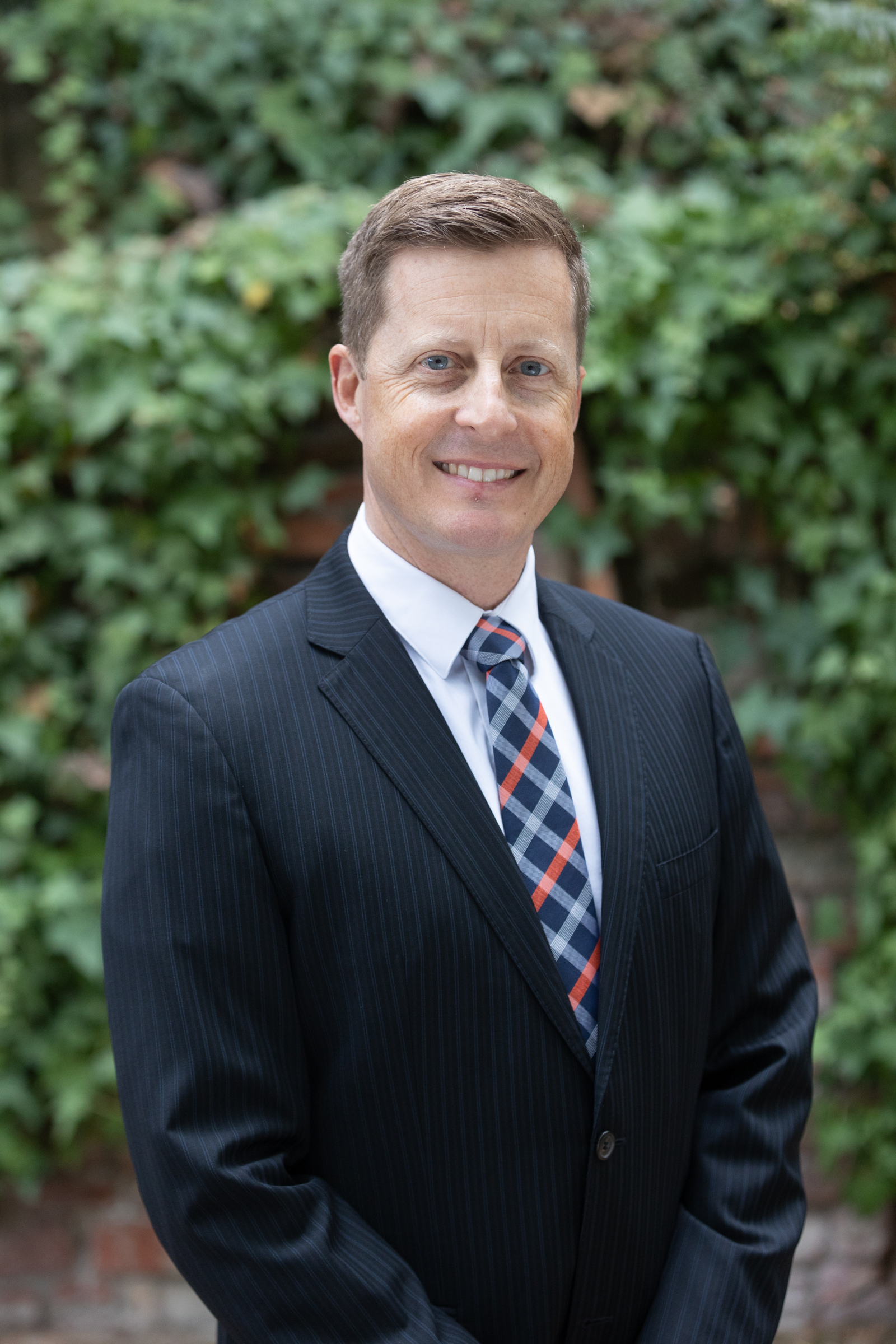
Travis Neal
Neal wrestled with the decision for about a week before concluding that his father had a point. He stayed at Stanford, which proved the smart call because the startup company went bust no more than a year later when the tech boom imploded.
His father’s well-measured advice had nudged rather than shoved Neal down the right path.
“The conversations I’ve had with my father about career, jobs, and family are generally more discussions than prescriptions,” says Neal.
The second poignant meal Neal had with his father was years later, after Neal had spent time working in Washington, D.C., earned his juris doctorate from Hastings Law School (now known as UC Law San Francisco), and joined Morrison Foerster as a young litigator.
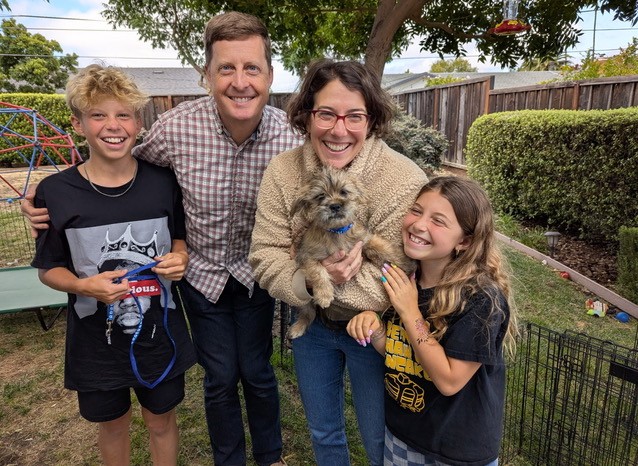
Travis with his wife, Nina, and their two children, Jesse and Elinor. Travis and Nina met while they were clerking.
His goal was to work on environmental regulatory matters, but his assignments largely involved defending a timber company in litigation, including leading a team of two dozen attorneys in reviewing terabytes of information. The experience broadened his understanding of litigation, but he found the work and pace of large-firm life unfulfilling.
Around that time, a lunch with his father changed his trajectory again. Seeing his son’s dissatisfaction, his father suggested that Neal consider joining his trusts and estates practice. Having grown up around that work, the idea resonated. Neal joined his father’s firm in Oakland, learning both the technical and personal dimensions of estate planning.
The change made sense to Neal. After all, he’d grown up in the Bay Area watching his father practice as a trust and estates attorney. His mother worked for Adult Protective Services in Contra Costa County and Neal heard stories around the dinner table of his mother’s caring for seniors and other vulnerable adults. For Neal, she was a model of empathy.
“I sort of grew up in the milieu of estate planning administration and looking after older adults,” he says. “So, I come by the practice honestly.”
His childhood in Oakland exposed Neal to a diverse citizenry, and he learned to navigate a range of situations and personalities.
“I think there’s a nimbleness that can develop by not living in a monoculture,” he says.
He acquired a lifelong love for reading, music, and art. His parents were intellectually curious, and the family frequented museums. His godmother introduced him to Merchant Ivory films when he was young and encouraged him to read 20th Century British authors such as E.M. Forester. He also gravitated toward reading plenty of science fiction and fantasy. A high school English teacher nourished his interest in writing.
At Stanford, Neal earned a degree in art history.
“People always ask what sort of pre-law major is art history? And I would argue it’s a very good pre-law major,” says Neal.
The degree required extensive writing centered around reflection and analysis. Much of it was persuasive writing, aimed at making a cohesive argument for why an artist’s work developed in a certain way or the importance of particular aspects of their work.
“It's a lot like legal writing,” explains Neal. “With art history, you were identifying an issue, laying out your theory as to why that issue was something that people should be interested in, and then justifying your theory and providing evidence for your theory.”
After graduating from Stanford, Neal headed east to the nation’s capital, where he worked as a paralegal at Covington & Burling LLP, a white-shoe law firm known for its litigation and regulatory work. Much of Neal’s time was spent working on behalf of tobacco companies, and he says the experience was formative.
“I learned to be aware of my prejudices and minimize how they affected my view of people or situations,” he says. “Coming from the Bay Area, I had a certain view of who would work for a tobacco company. That view lacked nuance and sympathy.”
Nowadays, one might simplify the lesson to Ted Lasso’s quote, “Be curious, not judgmental.”
He helped build and maintain a system that allowed for the tracking of local legislation. By the end of his first year working at the firm, he was convinced that he wanted to go to law school.
The following year, he returned to the Bay Area and enrolled at Hastings.
At Hastings, Neal split his summers between public defender offices – first in Contra Costa County, then in Washington, D.C. The experience, he says, was again formative, but it also confirmed that criminal defense wasn’t the right fit. The D.C. Public Defender Service, renowned in its field and unusually willing to pay interns, made a strong impression. That summer, he and a roommate drove cross-country to begin their internships and then back again at summer’s end – an adventure he still recalls fondly.
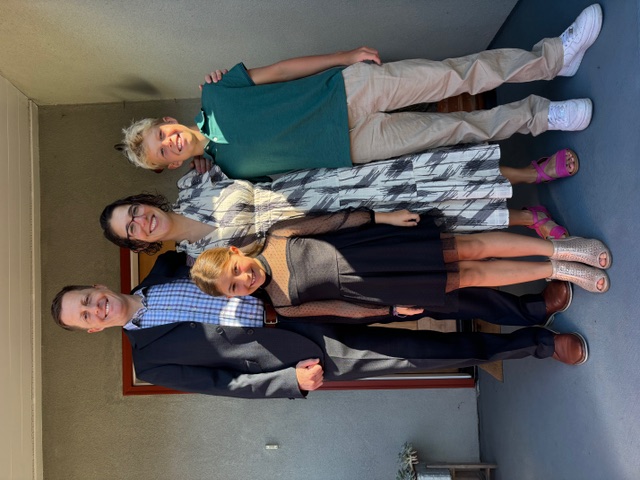
Much of Travis and Nina's free time is spent trying to keep up with their kids’ activities. Jesse plays travel baseball and Elinor is active in acro gymnastics.
By the time he finished law school, Neal knew he wanted to remain in the Bay Area. He had chosen Hastings over Emory in Atlanta with that in mind. During his 2L year, he interned for a local judge whose son-in-law was a partner in the environmental group at Morrison Foerster. That connection, though casual at first, became important later.
After graduation, Neal clerked for the U.S. District Court for the Northern District of California under Judge William W Schwarzer, who had taken senior status. Schwarzer, a former head of the Federal Judicial Center, often sat by designation on appellate panels. Neal’s clerkship included exposure to both district and appellate work, and he even traveled with the judge to Boston for a sitting – catching a game at Fenway Park while there.
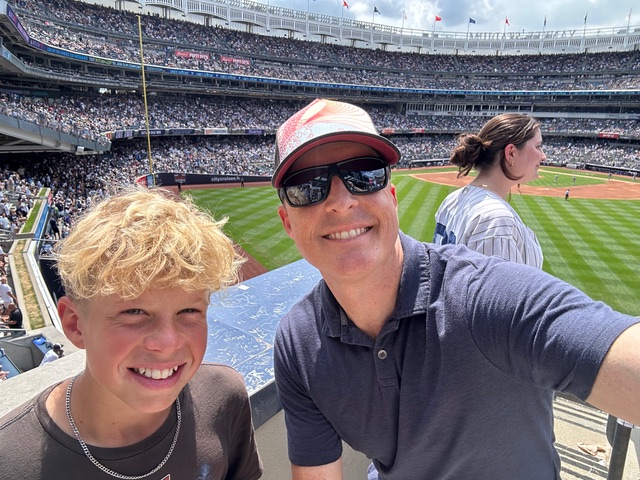
Neal has been a baseball fan since childhood, when his father began taking him to Oakland A’s games in the early 1980s. Those loyalties, however, faded when the team recently announced its relocation to Las Vegas. He now reserves his fandom for his son, who plays competitive travel baseball.
Following his clerkship, Neal joined Morrison Foerster before taking up his father on the offer to join his trust and estates practice.
After several years with his father, Neal felt it was time to move on. His father’s office was in the quiet Montclair Business District, and Neal wanted to expand his professional reach. He spent a few years at a firm in San Rafael before joining CEB, a legal publisher. At CEB he wrote and edited practice guides for attorneys – work that drew on his background in analysis and writing. He spent five years at CEB, enjoying what he calls “summer camp for legal nerds.” Eventually, he missed the direct client contact of private practice.
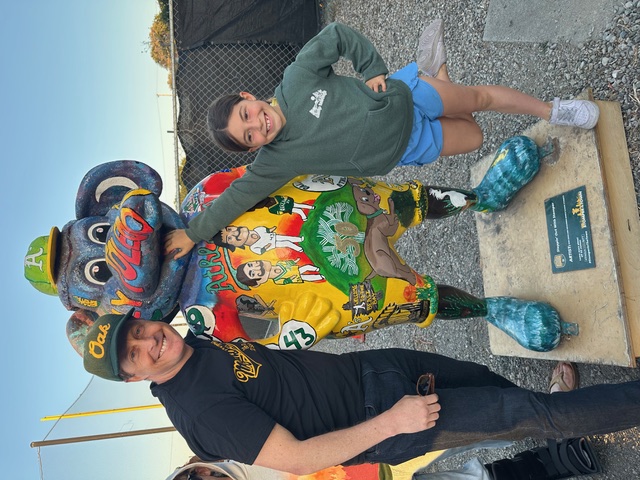
Travis and his daughter, Elinor, pose with a statue of Stomper, the mascot for the Oakland A's.
That pull brought him back to estate planning through a connection with Margaret Hand, a partner at Hartog, Baer & Hand LLP. Hand had written one of the books Neal edited at CEB, and when her firm had an opening in 2020, he applied. The work involved taxable estates – an area that was new to him – and he immersed himself in the technical details of tax law. He calls that period his “tax law boot camp,” during which he learned the intricacies of estate and gift tax returns and generation-skipping transfer tax rules.
Through a professional study group, Neal became friends with Brandon Spivak, who had previously held the position Neal filled at Hartog. A little over a year ago, Spivak reached out to let him know that his current firm, Brothers Smith LLP, was expanding and looking for another estate planner. Neal made the move, joining Brothers Smith, where he now divides his time between estate planning and administration.
He describes his approach to estate planning as grounded in understanding the individual. He believes an attorney must get to know clients well enough to encourage honest discussion about both their goals and their potential challenges. He also finds meaning in helping clients gain a sense of control over difficult topics.
“Done right, estate planning leaves people with peace of mind. They go from avoiding any discussion of their own mortality, to having a plan for how they and their loved ones will be cared for when they die,” says Neal. “It’s a process – you have to meet people where they are before they will open up – but it is a process I enjoy.”
He has a reputation, in fact, for his ability to engage with strangers in any setting or situation.
During a summer trip to Cooperstown, N.Y., where his son’s travel baseball team was competing in a tournament, Neal found himself chatting with one of the groundskeepers at the ballpark. In the course of a short conversation, he learned about the man’s years living in the area, the economic challenges the community faced, and the unusual hours the staff worked to prepare the fields each morning – starting at midnight once the teenage summer workers went home. It was the sort of interaction that comes naturally to Neal: casual, curious, and genuine, a brief exchange that leaves him knowing something about another person’s life.
Neal remains connected to the community outside of his practice. He serves as co-chair of the planning committee for the annual gala supporting Children’s Fairyland, a small Oakland storybook park that has been part of the city’s fabric for more than 75 years. His mother went there as a child, he went as a child, and now he takes his own children to the park. He also previously served on Berkeley’s Public Works Commission, advising on street-paving projects, infrastructure planning, and the naming of public spaces.
Neal and his wife, Nina, whom he met while they were both clerking, have two children – Jesse, age 12, and Elinor, age 9. Nina, a Columbia and New York University Law graduate, is a plaintiff’s-side employment lawyer focused on employee benefits under ERISA. Jesse plays travel baseball and Elinor competes in acro gymnastics. Most of the family’s free time, he says, is spent trying to keep up with their kids’ activities.
His office decor reflects the mix of his interests and influences: a print of Oakland, three framed covers from the Bridge School Benefit concerts, a Dave Stewart baseball card, an MC Hammer bobblehead, and a self-portrait by his wife’s grandmother, who was an artist, titled “The Sea Engulfs Us and the Light Goes Out.”
Neal’s ease in conversation with clients goes back to childhood. His father, a member of Toastmasters in the 1980s, used to bring him to meetings when he was in elementary school. The group opened each session with impromptu speaking exercises, and Neal learned early how to think on his feet.
That skill still serves him well. Whether in the office, on a baseball field in Cooperstown, or at a neighborhood event, he tends to strike up conversations and come away knowing someone’s story.
“I’m a fairly curious person,” he says, “and I think people are genuinely interesting.”