


Deadly contaminant makes its way from coast to coast, as does battle to contain it
By Tom Kirvan
PFAS.
They have come to be known as “forever chemicals” or “legacy contaminants.”
Whatever the label, they are more accurately described as toxic time bombs that can dramatically alter life in communities big and small across the nation, contaminating water used for drinking, bathing, as well as fishing, swimming, and other recreational uses.
PFAS stands for Per- and Polyfluoroalkyl Substances, a group of man-made chemicals that have been used in various industries and consumer products since the 1940s. The synthetic chemicals are known for their ability to repel water, grease, and stains, and are found in a range of items that includes non-stick cookware, firefighting foam, and water-resistant fabrics and consumer textile products like bedding, tablecloths, and sportswear.
Who could have known that the non-stick pan in your kitchen cupboard or that handy parka you don on a misty day could be so hazardous to your health?
Nearly 10 years ago, attorney Tony Spaniola learned that ignorance or ambivalence are not adequate defenses against the spread of PFAS.
For decades, Spaniola’s family has owned a vacation home on Van Etten Lake, not far from the wind-swept shores of Lake Huron near the northern Michigan town of Oscoda.
The lakeside cottage has served as a year-round get-away for the Spaniola family, offering a scenic and peaceful place where they can express their love for the water, the forests, and the nearby Sunrise Coast of Michigan.
And then, in 2016, their experience took a decidedly wrong turn when the Spaniolas received a troubling letter from the Michigan Department of Health and Human Services, advising them to stop drinking their well-water because the aquifer had been contaminated. Hundreds of other residents along Van Etten Lake received the same letter from the state, immediately sparking concern that before long would turn to disgust, outrage, and action.
The source of the contamination, residents soon learned, was traced to the decommissioned Wurtsmith Air Force Base that operated for 70 years in Oscoda before closing in 1993. There, at the base where scores of B-52 bombers were stationed during the height of the Cold War, resided a domestic-born enemy that for years had been leaching into nearby waters and aquifers at alarming levels.
“At Wurtsmith, which is an absolutely massive base on the other side of the lake from us, the Air Force had a special site where they practiced extinguishing jet fuel fires, spraying the planes with a foam that is made of PFAS,” said Spaniola, one of the founders of Ufer, Spaniola & Frost P.C. law firm in Troy, Mich. “This fire-fighting practice went on for years at Wurtsmith without any regard as to what the consequences would be to the environment.”
The fallout from the use of PFAS at Wurtsmith has spread far beyond its Great Lakes environs, developing into an ongoing state and national health crisis that has been linked to assorted medical problems related to cancer, liver disease, and immune system disorders.
“There are more than 300 confirmed PFAS sites in Michigan alone, and more than 11,000 potential sites in the state that remain to be tested,” Spaniola indicated. “The numbers are staggering, and while Wurtsmith was the first site in Michigan to be identified back in 2010, it was also the first identified U.S. military PFAS site in the world. Today, there are approximately 1,500 U.S. military PFAS sites world-wide, including more than 700 in the U.S. It’s a coast-to-coast problem in the U.S., and the U.S. military is the largest PFAS polluter in the country.”
An honors graduate of Harvard University, Spaniola has become a leading national voice for PFAS-impacted families and communities over the past decade, helping spearhead action on the local, state, and federal levels to address the use of harmful “forever chemicals.”
In 2017, Spaniola and Oscoda resident Cathy Wusterbarth co-founded Need Our Water (NOW), a community action group formed to take up the fight against PFAS contamination in the northern Michigan community.

“In 2016, it felt like a PFAS bomb was dropped by our own military and we were in shock,” said Wusterbarth, a registered dietician who was suddenly thrust into the role of “accidental activist” in the environmental battle. “We then desperately looked around to others for help. We saw how some people and organizations took swift action, and others like our polluter, the U.S. Air Force, and the regulator, the State of Michigan, sat on their hands, unable or unwilling to take action.”
The NOW group then gave rise to the Great Lakes PFAS Action Network (GLPAN) to “provide a voice for PFAS-impacted communities and people across the Great Lakes region,” according to Spaniola, co-founder of the organization that has a mission to prevent and clean up toxic PFAS contamination.
“It is absolutely essential to have impacted communities at the table when decisions are being made to address our water contamination issues,” Spaniola insisted, noting the importance of educating and informing decision-makers on the need for urgent action on the crisis.
“Do whatever you can to protect your family from PFAS contamination and exposures,” said Spaniola. “Ask questions, and don’t stop until you’ve gotten satisfactory answers. You are your own best advocate but always remember that you’re not alone. Reach out to GLPAN. Take advantage of GLPAN’s written resources and talk with others in your community and the GLPAN family of communities. We are all in this together.”
The residents of Emmaus, a borough in the Lehigh Valley of Pennsylvania, can attest to that after discovering that their water supply was heavily tainted with PFAS.
According to an August 17 article published by USA Today, Emmaus was among 839 water systems whose yearly average exceeded Environmental Protection Agency limits for two types of PFAS. Together, the water utilities serve 46 million Americans, according to the USA Today analysis.
In the case of Emmaus, the contamination averaged 32 times the federal limit over the past year. The source of the pollution is a firefighter training facility where fire-extinguishing foams containing PFAS seeped into the local aquifer during training exercises, according to Borough Manager Shane Pepe.
“While our firefighters were practicing to save your life, they had no idea that at the same time the water system was getting poisoned,” Pepe said in the USA Today article.
Now, municipalities like Emmaus are grappling with how best to remediate the pollutants without breaking the budget, particularly as it relates to installing water treatment tanks that can filter out PFAS. The costs are considerable and can run into the millions of dollars, according to environmental experts.
The cost concern has been exacerbated in recent months by reports that the Trump administration wants to rescind some PFAS limits at the urging of various industry groups that utilize the product.
The potential backpedaling could undo much of the work that attorney Spaniola helped bring about when the first-ever national PFAS drinking water standards were established in 2024.
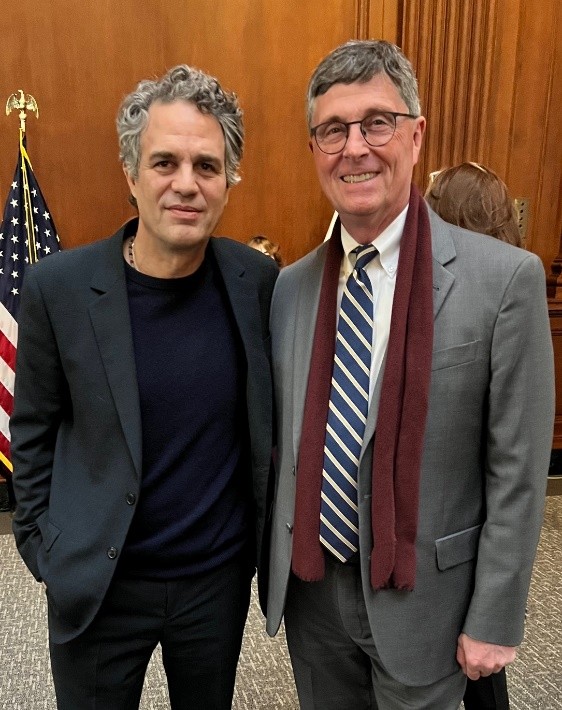
Actor Mark Ruffalo, who starred in the 2019 film “Dark Waters” that traces the long legal fight against DuPont for poisoning the water in a West Virginia community, is pictured with Tony Spaniola at EPA Headquarters in Washington in January 2024.
By that time, Spaniola had been involved in crafting an “expedited PFAS cleanup strategy that was adopted by the Pentagon as a national policy directive at more than 700 military installations around the country.” His efforts also led to the “reorganization of the U.S. Air Force’s environmental cleanup program at 39 inactive Air Force installations nationwide – and to the establishment of the Bipartisan Congressional PFAS Task Force, which currently numbers more than 50 members of the U.S. House of Representatives.”
In 2019, Spaniola’s work attracted the attention of Pulitzer Prize-winning journalist Sara Ganim, who at age 24 broke the story that uncovered the sexual abuse of young boys by Penn State assistant football coach Jerry Sandusky.
“Sara originally approached me about being part of a chapter in a book she was writing, but once she got a sense of how involved and widespread this PFAS problem is, she decided to turn it into a documentary film instead,” Spaniola explained.
The result was the critically acclaimed “No Defense: The U.S. Military’s War on Water,” a 75-minute documentary that highlights the poisonous impact on the Oscoda community, as ground zero for PFAS-impacted military communities across the nation. The film premiered at a sold-out Michigan Theater in Ann Arbor in February 2020, just weeks before the COVID lockdown began.
“It’s a powerful documentary that brings to light the devastating impacts that PFAS can have on families, on a community, and on our country,” said Spaniola, who served as a consultant to Ganim in the production of the film. “In many respects, it is another true story of the likes of ‘Erin Brockovich’ and ‘Dark Waters.’ It’s a movie that should be seen by all.”