

Andrew Carnegie
Articles
Famous Quotes
View more from News & Articles or Primerus Weekly

By Tom Kirvan
“Wealth is not to feed our egos but to feed the hungry and to help people help themselves.”
The words were uttered by industrialist Andrew Carnegie, one of the 19th century robber barons of America’s Gilded Age who came to the United States from Scotland as part of a family that was dirt poor.
Born November 25, 1835, Carnegie landed his first job at age 12 in a Pittsburgh railroad office, climbing up the ranks to become manager by the time he was 20 and was his family’s main breadwinner. He eventually became enamored with the steel business after using the alloy to build a bridge that spanned the Mississippi River in St. Louis.
Before long, the steel business was booming as the product was used in building skyscrapers, rail lines, sports stadiums, and office structures, making Carnegie a fortune and an industrial rival of oil tycoon John D. Rockefeller and shipping magnate Cornelius Vanderbilt.
At the time of the massive industrial expansion in the U.S., the enormously wealthy Carnegie made a conscious decision to become a leading philanthropist in his adopted country and Great Britain, donating more than $350 million to various charities in both countries.
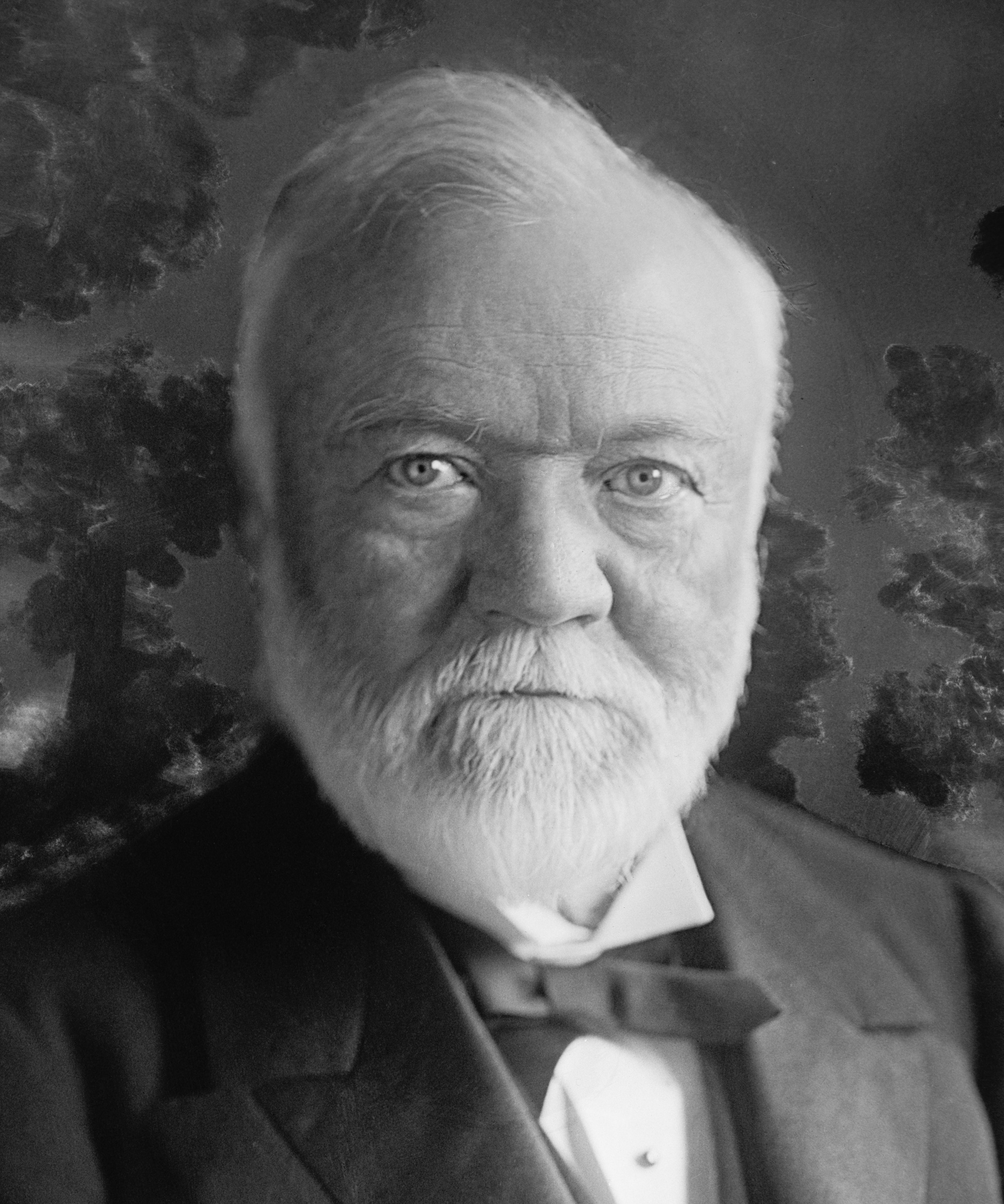
His generosity, which amounted to the equivalent of nearly $7 billion in today’s dollars, targeted the areas of education, scientific research, and the arts. He made a special emphasis on building local libraries (some 2,500 worldwide), while also funding the construction of Carnegie Hall in New York, Peace Palace in The Hague, and Carnegie Mellon University in Pittsburgh.
With great wealth comes great responsibility, Carnegie said in his later years, insisting, “The man who dies thus rich dies disgraced.”
When asked to reveal the primary secret to his success, Carnegie responded: “Teamwork is the ability to work together toward a common vision. It is the fuel that allows common people to attain uncommon results.”
*Theodore C. Marceau, Public domain, via Wikimedia Commons