

Minnesota Travelogue
Articles
Travelogues
View more from News & Articles or Primerus Weekly


By Tom Kirvan
Nestled in the upper Midwest of the United States, Minnesota is a state that surprises visitors with its mix of natural beauty, cultural vibrancy, and storied history. With a population of approximately 5.7 million people, Minnesota is often associated with lakes, snow, and Scandinavian charm – but it offers far more than that. From its twin urban centers to its serene wilderness, Minnesota invites travelers to explore a state shaped by glaciers, immigrants, and innovation.
Minnesota is often referred to as “The North Star State” and is nicknamed the “Land of 10,000 Lakes,” though in reality, it has closer to 12,000. The state is bordered by Canada to the north, Wisconsin to the east, Iowa to the south, and the Dakotas to the west. It stretches from the Mississippi River’s headwaters in the south to the rugged beauty of the Boundary Waters Canoe Area Wilderness in the north.
The capital city, Saint Paul, sits on the eastern bank of the Mississippi River and forms half of the famous Twin Cities with the adjacent Minneapolis. While Saint Paul is steeped in historic architecture, state government, and old-world charm, its twin, Minneapolis, bustles with modern energy, world-class museums, and a thriving arts scene.
Minnesota’s highest point is Eagle Mountain, standing at 2,301 feet above sea level. Located in the Superior National Forest near the Canadian border, Eagle Mountain offers moderate hiking trails through boreal forest to a summit with views of untouched lakes and wilderness. While not especially tall by national standards, it’s a fitting peak for a state where nature quietly dominates.
Minnesota’s human history stretches back thousands of years, with Native American peoples such as the Dakota (Sioux) and Ojibwe (Chippewa) living in the region long before European settlement. The state’s name itself comes from two Dakota words “mní sóta,” meaning “clear blue water” and “Mníssota” meaning “cloudy water.”
In the 1800s, waves of Scandinavian, German, and Irish immigrants transformed Minnesota into a farming and milling powerhouse. Minneapolis became a hub for flour production, earning it the nickname “Mill City.” Historic mills along the Mississippi River – now part of the Mill City Museum – tell the story of the state’s industrial rise.
Minnesota also played a vital role in the fight for civil rights and progressivism. It was the home of Hubert H. Humphrey, vice president under Lyndon B. Johnson and a staunch advocate for civil rights. More recently, the state became a center of national attention following the death of George Floyd in 2020, sparking global conversations on justice and equality.
The seasons shape life in Minnesota in powerful ways. Winter brings snowshoeing, ice fishing, and the Saint Paul Winter Carnival, while summer means boating, camping, and the legendary Minnesota State Fair, one of the largest in the country.
Five Must-See Destinations

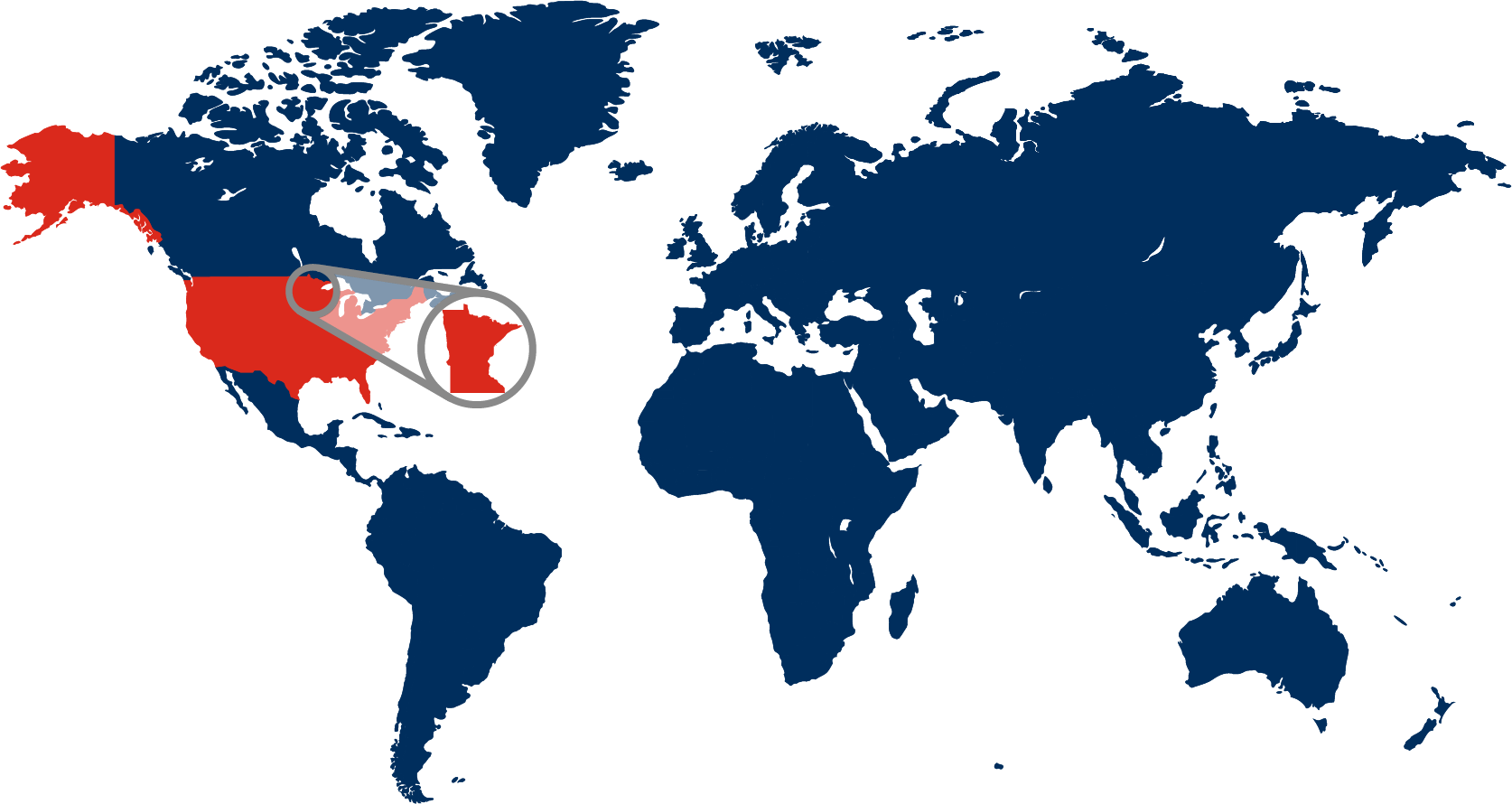
Capital: St. Paul
Population: 5.7 million
Economic engines: Manufacturing, life sciences, agriculture, and tourism
Highest Point: Eagle Mountain (2,301 feet)
Primerus Members:
Bernick Lifson, PBLI
(Minneapolis, Minnesota, U.S.)
Bernick Lifson, a full-service business law firm located in Minneapolis.
O’Meara Wagner, P.A., PDI
(Minneapolis, Minnesota, U.S.)
O’Meara Wagner P.A., a full-service business defense firm located in Minneapolis.