

Neil Armstrong
Articles
Famous Quotes
View more from News & Articles or Primerus Weekly

By Tom Kirvan
He traveled some 240,000 miles to utter one of the most famous quotes in American history, 11 words that momentarily seemed to unify the world.
“That’s one small step for man, one giant leap for mankind,” said astronaut Neil Armstrong as he set foot on the Moon on July 20, 1969 as more than 450 million people watched the worldwide telecast of the momentous technological feat.
Born August 5, 1930 in Wapakoneta, Ohio, Armstrong spent 21 hours and 36 minutes on the Moon during the Apollo 11 mission, teaming with fellow astronaut Buzz Aldrin to explore the lunar surface, collect rock samples, and perform scientific experiments.
At the age of 16, Armstrong earned his student pilot’s license, obtaining it before he had a driver’s license. He attended Purdue University on a Naval scholarship, studying aeronautical engineering. As part of his scholarship, Armstrong underwent Navy training as a fighter pilot, a role he fulfilled during the Korean War, where he flew 78 combat missions.
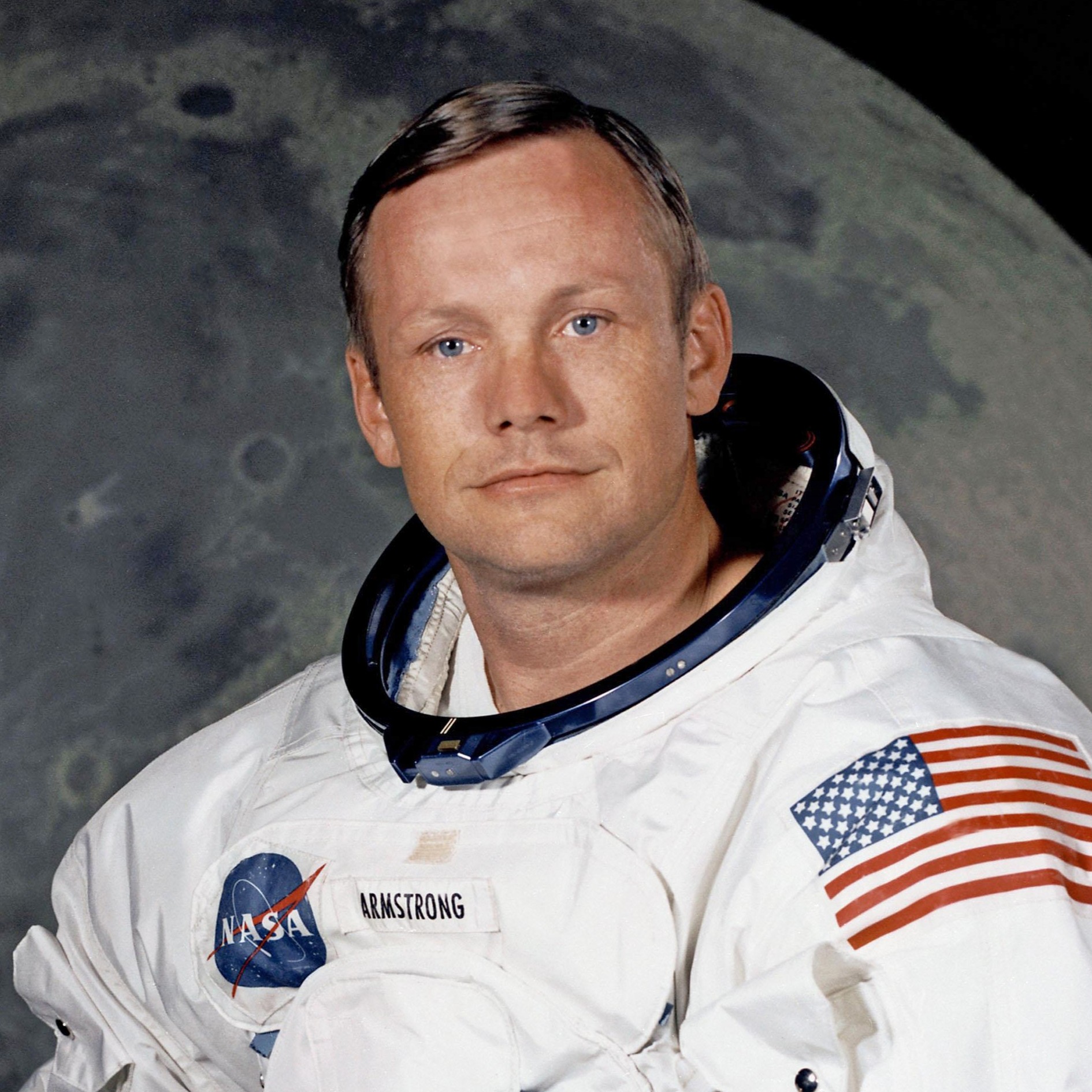
During seven years as a test pilot for NASA, Armstrong flew 200 different aircraft, including the needle-nosed X-15, which reached speeds of more than 4,000 mph. In 1962, Armstrong was chosen for NASA’s astronaut training program in Houston. The joy of his selection was quickly tempered when he and his wife, Janet, lost their second child, a 2-year-old daughter, to an inoperable brain tumor.
When Armstrong was chosen as the commander for Apollo 11, he reportedly was picked because of his calm confidence and total lack of ego, which he continued to display even after the successful lunar mission that at the time made him the most famous man on Earth.
Two years after the Moon landing, Armstrong retired from NASA and took a job as an engineering professor at the University of Cincinnati, remaining out of the limelight until 1986 when he joined the Rogers Commission that was impaneled to investigate the tragic Challenger shuttle explosion.
Tragedy would play a part in Armstrong’s 2012 death when he died two weeks after undergoing heart bypass surgery at the age of 82. Members of his family secretly claimed that the death was caused by medical malpractice, a contention that seemingly was bolstered years later when word of a $6 million settlement between the hospital and the plaintiffs was revealed in a series of newspaper articles.
Despite the circumstances surrounding his death, Armstrong may have written his own heady epitaph during an interview following the lunar landing.
“I am, and ever will be, a white-socks, pocket-protector, nerdy engineer, born under the second law of thermodynamics, steeped in steam tables, in love with free-body diagrams, transformed by Laplace, and propelled by compressible flow,” he said.