Foreign Companies Operating in Italy?
many other countries around the world
have been creating provisions aiming to
hold corporations liable for committing
criminal offenses for their own advantage.
Principally, these provisions seek to
prevent corrupt practices and similar
offenses and lead to the adoption of
dispositions set out by the Organisation for
Economic Co-operation and Development
(OECD) Convention on Combating Bribery
of Foreign Public Officials in International
Business Transactions, known also as the
OECD Anti-Bribery Convention (Paris,
December 1997).
The Italian Republic followed
this legislative trend by adopting in
2001 Decree No. 231 concerning the
"administrative liability of legal entities
deriving from the commission of criminal
offenses" (hereinafter the "Decree"). As
a result of this Decree, criminal sanctions
are now applicable against companies,
not just against individuals. Companies,
whether resident or non-resident,
territory, are thus liable for not only
severe pecuniary sanctions but, even more
seriously, debarment which leads to the
forced suspension of business activities.
This is an additional liability, separate
from the specific individual liability of the
person committing the criminal offenses
and also separate from ordinary liability
for damages.
This risk arises (in broad terms)
whenever a criminal offense is committed
by an individual in the interest of a
company (however minimal). One of the
main differences between Italian law and
similar laws in other countries is that
the Italian system aims to sanction a far
wider range of criminal offenses than
the "usual" bribery or corruption (e.g.
environmental criminal offenses, criminal
offenses regarding the health and the
safety of workers, computer and IT crimes,
immigration-related criminal offenses,
corporate criminal offenses and so on
collectively as "231 offenses").
liability under the Decree are as follows:
managers of the company or by one
of its operative units ("managers"),
including those individuals who
are responsible for the de facto
management and control of the
company or by individuals subject to
their direction or supervision ("non-
managerial employees");
company's advantage. The company is
not liable if it can be proved that the
individual acted in his own interests or
for the interests of a third party;
liability are, first, fines (up to 1.5
million euros) and the forfeiture of all
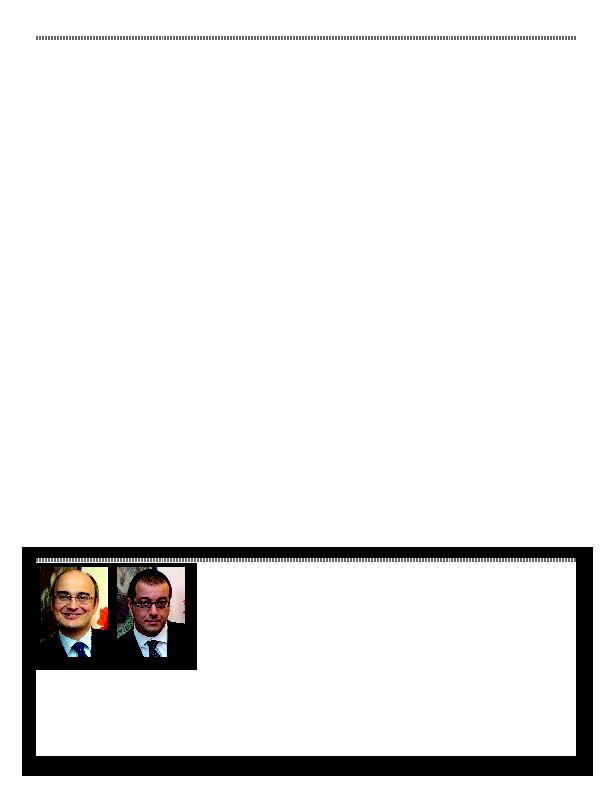
the Studio Legale F. De Luca in Milan, Italy. Mr. Bico, the author of
numerous academic books and papers, practices in the area of
white collar crime. Mr. De Luca focuses his activity in tax litigation
and compliance. They jointly assist international corporations
dealing, respectively, with matters relating to criminal law, tax and
compliance issues.
Piazza Borromeo, 12
Milan, Italy 20123
+39 02 805 2565 Fax
deluca@delucastudiolegale.it
deluca1974.it